What Is Customer Feedback and Why Does It Matters?
Customer feedback is the single most reliable signal you have about what's working and what isn't. Here's what it actually is, the different forms it takes, and why ignoring it is the costliest mistake a growing business can make.
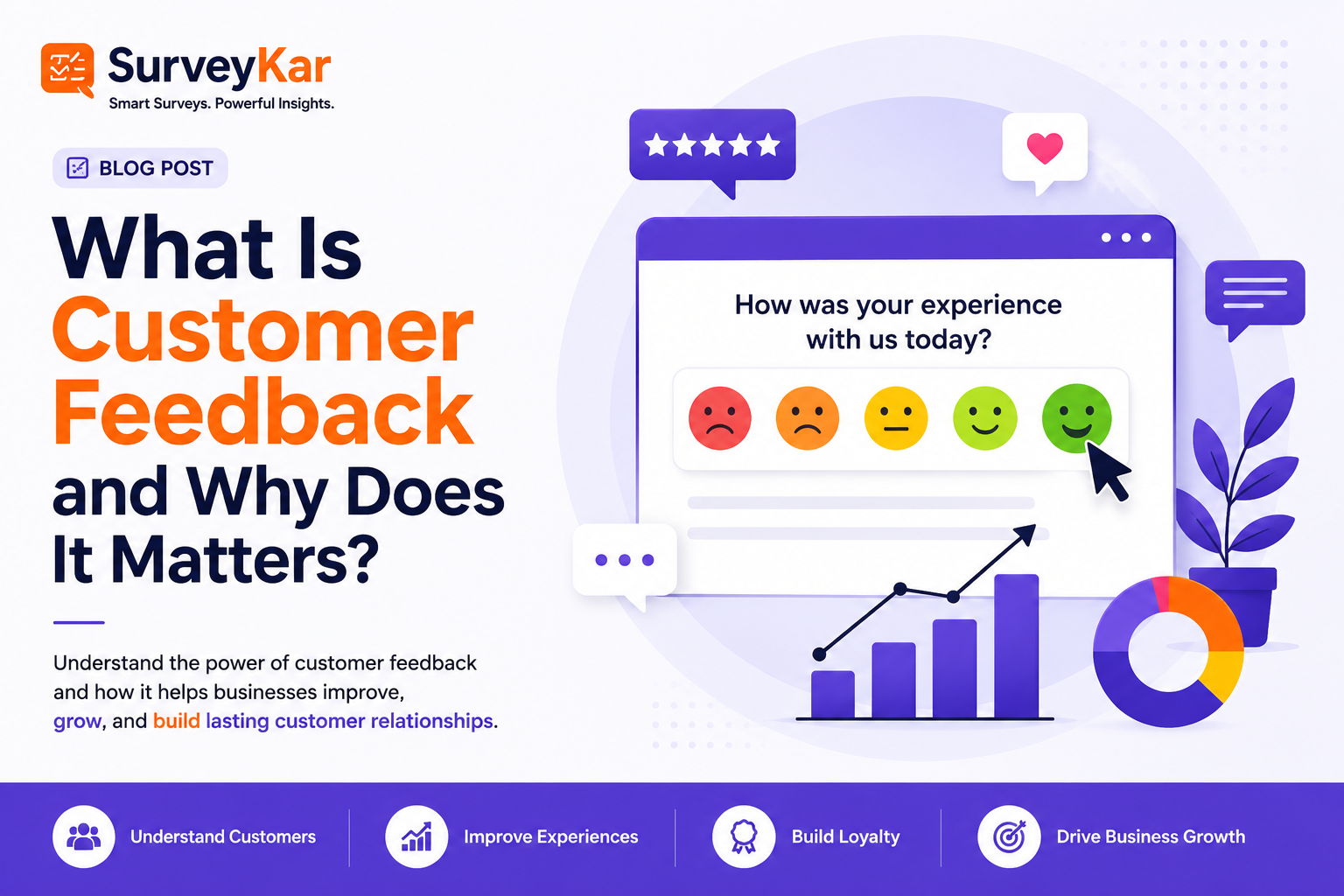
Every business collects opinions whether it asks for them or not — a one-star review, a shrug in a support chat, a churned subscription with no explanation. The businesses that grow deliberately are the ones that turn those scattered signals into something they can act on. That's customer feedback: not a nice-to-have, but the raw material for every good decision you'll make about your product, pricing, and experience.
What is customer feedback?
Customer feedback is any information a customer shares about their experience with your product, service, or brand — what they like, what frustrates them, what they expected but didn't get. It can arrive as a star rating, a detailed support ticket, a comment on social media, or a considered answer to a survey question.
The important distinction isn't the format — it's whether the feedback is solicited (you asked for it) or unsolicited (it arrived on its own), and whether it's qualitative (open-ended, descriptive) or quantitative (a number or rating you can track over time).
The main types of customer feedback
- Solicited feedback — collected on purpose, through surveys, feedback forms, interviews, or review requests. You control the timing and the question.
- Unsolicited feedback — customers volunteering opinions unprompted, via reviews, social media, support tickets, or word of mouth. It's often more emotionally charged, and it tells you what customers care about enough to say without being asked.
- Quantitative feedback — structured, numeric, and easy to track over time. Think NPS (Net Promoter Score), CSAT (Customer Satisfaction Score), and CES (Customer Effort Score).
- Qualitative feedback — open text, interviews, and comments. Harder to measure at scale, but it explains the why behind the numbers.
A mature feedback program uses all four — the numbers tell you where to look, and the open-ended responses tell you what's actually happening there.
Why customer feedback matters
1. It tells you what to build next
Feature requests, complaints, and confused support tickets are a free, ongoing product roadmap. Teams that skip this step end up guessing — building what they assume customers want instead of what they've actually said.
2. It catches problems before they become churn
A customer who's quietly frustrated rarely emails you to complain — they just leave, and often without warning. A well-timed feedback survey (after onboarding, after a support interaction, at renewal time) surfaces friction while there's still time to fix it.
3. It's a leading indicator, not a lagging one
Revenue and churn numbers tell you what already happened. Feedback — especially recurring themes across many responses — tells you what's about to happen. That gap is exactly the window where a business can still act.
4. It builds trust and loyalty
Asking for feedback signals that you're listening. Closing the loop — telling customers what changed because of what they said — turns a one-time respondent into an advocate. Silence, on the other hand, reads as indifference, even if you privately made the fix.
5. It's cheaper than acquiring new customers
Every business already knows retention is more cost-effective than acquisition. Feedback is the mechanism that makes retention actionable — it tells you exactly which experience gaps are pushing customers toward the exit, so you can close them before they cost you a renewal.
How to actually collect useful feedback
Collecting feedback well matters as much as collecting it at all. A few principles that consistently work:
- Ask at the right moment. Right after a purchase, a support resolution, or a key product milestone — while the experience is still fresh.
- Keep it short. A five-minute survey gets abandoned. A two-question survey gets answered.
- Mix scales and open text. A single NPS or CSAT question gives you a trackable number; one follow-up open text question ("What's the main reason for your score?") gives you the context to act on it.
- Make it easy to respond from anywhere. Email, in-app prompts, and channels like WhatsApp all lower the barrier to reply compared to asking someone to log into a separate portal.
- Close the loop. Even a short "here's what we changed based on your feedback" message meaningfully increases future response rates.
Turning feedback into action
Collecting feedback is only half the job — the value shows up when it changes a decision. That means routing responses to the right team, tracking recurring themes over time instead of reacting to single data points, and revisiting your NPS/CSAT trend regularly rather than only after something's already gone wrong.
This is exactly the gap tools like SurveyKar are built for — creating short, targeted surveys, sending them over email or WhatsApp at the moment they matter most, and tracking sentiment over time so feedback turns into a repeatable system rather than a one-off event.
The bottom line
Customer feedback isn't a box to check after launch — it's an ongoing conversation with the people who decide whether your business grows. The companies that ask consistently, listen closely, and act visibly are the ones that build products people stay with. The ones that don't are left guessing, and finding out too late.
Frequently asked questions
Any information a customer shares about their experience with your product, service or brand. It arrives as a star rating, a support ticket, a social media comment or an answer to a survey question — the format matters less than whether you asked for it, and whether it is a number you can track or an explanation of why.
Solicited feedback is collected on purpose through surveys, feedback forms, interviews or review requests, so you control the timing and the question. Unsolicited feedback arrives unprompted through reviews, social media or support tickets. It is usually more emotionally charged, because the customer cared enough to say it without being asked.
Both. Quantitative scores like NPS, CSAT and CES are easy to track over time and tell you where to look. Open-ended answers tell you what is actually happening there. A mature feedback programme uses the numbers to find the problem and the comments to explain it.
As close to the moment you are measuring as you can manage — after onboarding, after a support interaction, or at renewal. Feedback collected a week later measures memory rather than experience.
Pick one moment that matters, pair a single scored question with a single open question, and send it close to that moment. A free customer feedback template gives you both questions already written, so the first survey takes minutes rather than an afternoon.
Keep reading
All articlesWhat Is a Good NPS Score? How to Read Yours (Without Fake Benchmarks
The short answer is a set of general bands that the industry uses as a rough guide. The honest answer is that “good” depends almost entirely on your own previous score, not on a table of industry averages you found online.